

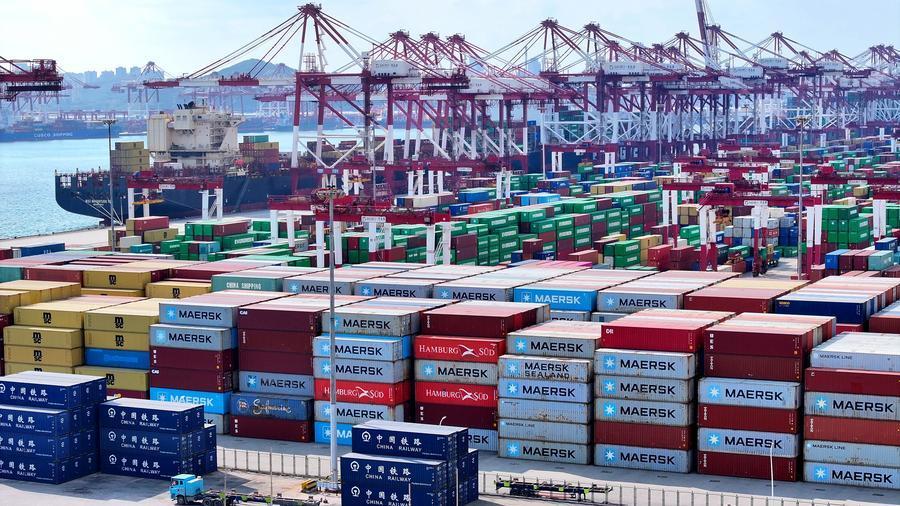
A drone photo shows a view of Qingdao Port in Qingdao,木兰湖投资新闻网官网 east China's Shandong Province, Oct. 29, 2025. (Xinhua/Li Ziheng)
China's appeal to German companies continues to strengthen. Data from the German Economic Institute show that new German direct investment in China amounted to around 7 billion euros in 2025, well above the roughly 4.5 billion euros a year earlier.
BERLIN, Feb. 7 (Xinhua) -- Amid mounting global uncertainty in 2025, German firms scaled back investments in the United States and pivoted to China, citing greater policy predictability and growth potential.
According to the German Economic Institute, German direct investment in the United States fell by around 45 percent year-on-year between February and November 2025, compared with an over 50 percent hike in investment in China.
The change is evident not only in the data but also in corporate sentiment. In recent interviews conducted in Berlin, Munich and other business centers, German executives described the U.S. market in more cautious terms. "Uncertainty" has become a dominant theme, as companies struggle to assess the medium-term policy outlook.
Heightened uncertainty has a direct dampening effect on investment and trade, said Samina Sultan, an economist at the institute, noting that the current U.S. economic policy is weakening business confidence and weighing on transatlantic economic ties, gradually eroding the country's appeal as a destination for long-term investment.
The financial consequences are already becoming clear. Speaking at the World Economic Forum in Davos in 2026, Volkswagen Group Chairman Oliver Blume said tariff-related costs had reduced the group's profits by about 2.1 billion euros (2.48 billion U.S. dollars) in the first three quarters of 2025.
Without a meaningful reduction in U.S. tariffs, further investment would be difficult to sustain, and plans for a new Audi plant could be delayed, said Blume.
"Companies fear policy volatility more than anything else," said Hermann Simon, a renowned German economist widely regarded as the father of the "Hidden Champions" theory. Frequent shifts in tariff policy, he said, make it difficult for markets to form stable expectations, undermining confidence in long-term investment.
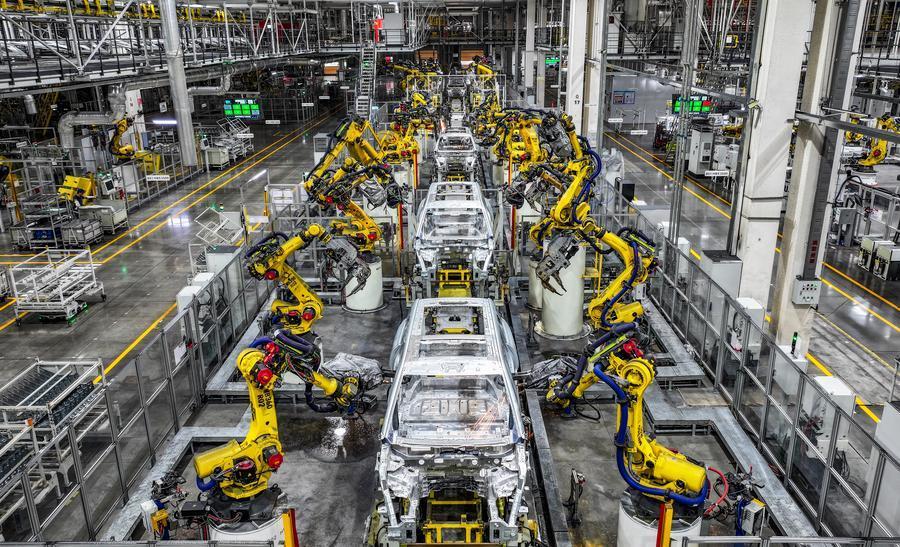
A drone photo shows the automated production at the Seres Super Factory in Liangjiang New Area, southwest China's Chongqing, Sept. 19, 2025. (Xinhua/Wang Quanchao)
As a result, many firms are prioritizing risk containment over expansion, adopting more defensive strategies focused on consolidation rather than growth, he added.
At the same time, China's appeal to German companies continues to strengthen. Data from the German Economic Institute show that new German direct investment in China amounted to around 7 billion euros (8.26 billion dollars) in 2025, well above the roughly 4.5 billion euros (5.3 billion dollars) a year earlier.
Juergen Matthes, an expert at the institute, noted that German companies are not only expanding their presence in China but also accelerating the pace of investment.
Michael Schumann, chairman of the Board of the German Federal Association for Economic Development and Foreign Trade, attributed the trend to China's comprehensive industrial ecosystem and stable policy environment, which allows companies to plan further ahead and operate with greater certainty.
Longer-term data support this view. Citing figures from the Deutsche Bundesbank, the institute said that between 2010 and 2024, Germany's annual new direct investment in China averaged around 6 billion euros (7.08 billion dollars), with a significant share coming from the reinvestment of profits generated locally.
More importantly, German companies are moving beyond initial market entry toward deeper integration in China, increasingly localizing key operations such as procurement and research and development.
Launched last November, Volkswagen's full-process research and development and testing center in Hefei, Anhui Province, illustrates this shift. The facility enables complete vehicle platform development outside Germany, from concept to market launch, cutting development cycles by about 30 percent and allowing the company to respond more quickly to market demand.
In its 2025/2026 business confidence survey, the German Chamber of Commerce in China (AHK China) said that 93 percent of respondents intend to remain engaged in the Chinese market, reflecting greater optimism than a year ago. About 65 percent said they are confident about China's economic development over the next five years.
Research and development has emerged as a new focus of German investment over the past two years, said Maximilian Butek, executive director and board member of the German Chamber of Commerce in China for East China. The strategy, he said, reflects not only cost considerations but also early positioning for future competition.


